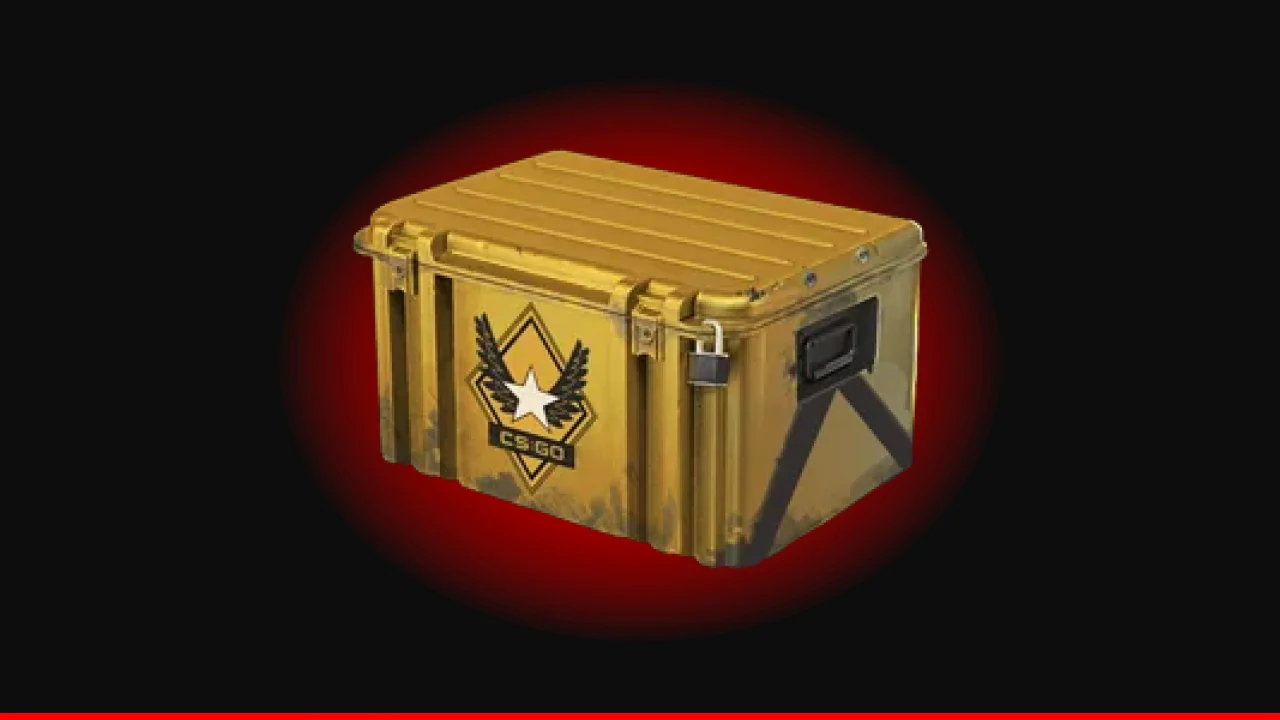
Every time you open a CS2 case, you are participating in a system with precisely defined probabilities. Valve publishes the official drop odds for CS2 cases, and understanding them — alongside the expected value math — will give you a clear picture of what case opening actually costs and delivers. This guide breaks down exactly how the odds work, what each rarity tier pays out, and why the math almost always favours not opening.
Official CS2 Case Drop Rarity Odds
Valve is legally required in many markets to disclose the probabilities of in-game item drops, and CS2 is no exception. The official odds for a standard weapon case are:
| Rarity Tier | Colour | Drop Chance |
|---|---|---|
| Mil-Spec Grade | Blue | 79.92% |
| Restricted | Purple | 15.98% |
| Classified | Pink | 3.20% |
| Covert | Red | 0.64% |
| Rare Special Item (knives/gloves) | Gold | 0.26% |
These are the base odds for any standard weapon case. Souvenir packages use different odds weighted toward lower-rarity items but follow the same tier structure. Note that the Rare Special tier (0.26%) covers the entire pool of knives or gloves in that case — your chance of getting any specific knife is a fraction of that 0.26%.
StatTrak Chance
Any item in a case except knives and gloves has approximately a 1-in-10 chance (10%) of being StatTrak. StatTrak weapons track kills and typically trade for 25-50% more than their non-StatTrak equivalents at lower rarities, and considerably more at Covert and above. StatTrak knives and StatTrak gloves do not exist — the Rare Special tier always drops standard versions.
Wear and Float Values on Unboxed Items
When an item drops from a case, it is immediately assigned a float value — a number between 0.00 and 1.00 that determines its wear condition. The float is generated randomly within the allowed range for that specific skin (not every skin can be Factory New or Battle-Scarred). The five wear tiers are:
- Factory New (FN) — float 0.00-0.07
- Minimal Wear (MW) — float 0.07-0.15
- Field-Tested (FT) — float 0.15-0.38
- Well-Worn (WW) — float 0.38-0.45
- Battle-Scarred (BS) — float 0.45-1.00
Lower float numbers within Factory New are called «low float» and command a price premium on the market. A 0.001 FN skin can be worth substantially more than a 0.069 FN of the same item. See our full CS2 Skins guide for float details and how to check your skin’s float value.
Expected Value Math: Why Most Opens Lose Money
The expected value (EV) of opening a case is the sum of each possible outcome multiplied by its probability. For almost every CS2 case, EV is significantly negative when you factor in the key cost.
A CS2 case key costs $2.49 USD on Steam (price may vary slightly by region). The case itself either drops for free during play or can be purchased from the Steam Community Market — many common cases trade for $0.05-$0.50.
For a rough EV estimate on a typical case, consider:
- ~80% of opens produce a Mil-Spec (blue) skin worth $0.05-$0.30 on the market.
- ~16% produce a Restricted (purple) skin worth $0.20-$2.00 typically.
- ~3.2% produce a Classified (pink) skin worth $1-$15 on average.
- ~0.64% produce a Covert (red) skin — these can range from $10 to several hundred dollars depending on the case and skin.
- ~0.26% produce a knife or gloves — the items players hope for, often worth $100-$1,500+ depending on skin and float.
Running the weighted average across a popular case, the average return per open typically comes in well below the $2.49 key cost plus case price. The median outcome (what most openers actually receive) is a blue skin worth less than $0.20. The knife probability means you would need to open an average of roughly 385 cases to expect one knife — at $2.49 per key, that is roughly $960 in keys alone before you account for case costs.
The Pity System (Unconfirmed by Valve)
Valve has never officially confirmed a «pity» or guaranteed drop mechanism for CS2 cases. Unlike some other games with explicit pity timers, CS2’s published odds are independent per open — each case has the same 0.26% knife chance regardless of how many you have opened previously. Community data has not conclusively demonstrated a hidden pity mechanic.
How Cases Enter the Economy
Cases drop randomly to players at the end of matches, with a weekly drop limit per Steam account. The drop pool rotates — older cases may leave the active drop pool but remain available on the Steam Community Market. Case prices on the market fluctuate based on supply (how many dropped) and demand (desirability of the contained skins). Browse available CS2 Cases and check current market values for specific CS2 Skins.
Should You Open Cases?
From a pure financial standpoint, case opening is entertainment spending with a negative expected return. If you enjoy the experience of opening and understand you are paying for the excitement rather than a reliable investment, that is a personal choice. If your goal is to acquire a specific knife or skin, buying it directly from the Steam Community Market or a trusted third-party marketplace is almost always cheaper than attempting to unbox it. The odds make targeted unboxing a very expensive lottery.
Conclusion
CS2 cases are a transparent gambling mechanic with published odds. The numbers clearly show that the vast majority of opens produce low-value blue and purple items, that knives and gloves are extremely rare at 0.26%, and that the key cost alone exceeds the median return per open. Open cases for the fun of it if you wish — but do so with a realistic understanding of the math behind each click.
Comments